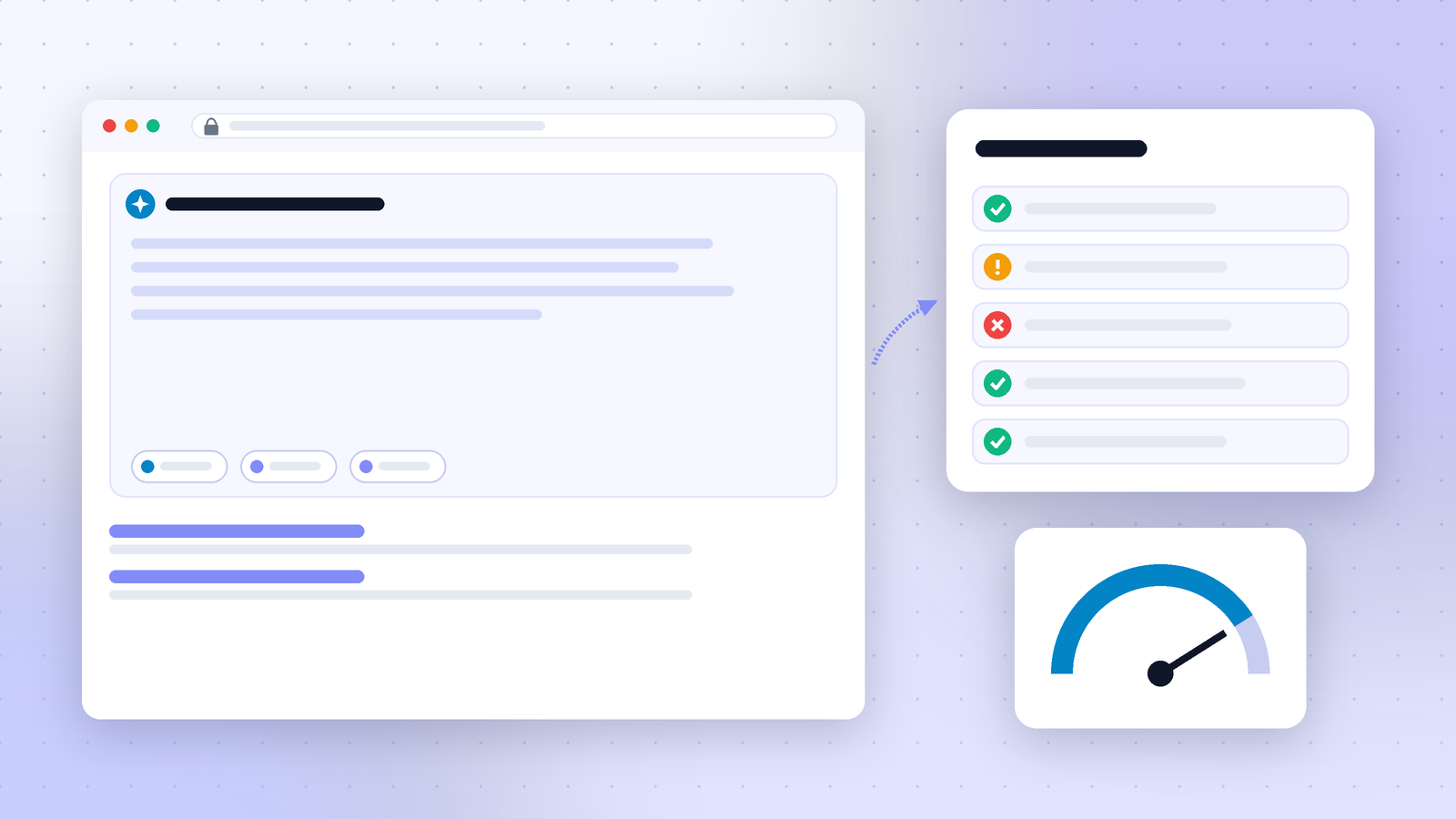
In the past week alone, Google's AI Mode has shown ads with blue titles instead of black ones.1 It has shown three ads at the bottom of an answer instead of two.2 And some ads show a website name while others show a URL.3 Google announced none of these.
Below, we sort what Google has confirmed from what has only been spotted in tests, as of October 12, 2026.
AI Mode is the chat-style tab in Google Search. You ask a longer question, and Google writes an answer with links. It is different from AI Overviews, which is the short AI summary that appears at the top of a normal results page.
This week's sightings: all tests, none confirmed
Search Engine Watch reported each of these from screenshots.
| What was seen | Before | After | Status |
|---|---|---|---|
| Ad title color at the bottom of AI Mode | Black titles | Blue titles, the color people link with clickable links | REPORTED, test (October 9)1 |
| Number of ads at the bottom of AI Mode | Two ads | Three ads | REPORTED, scope unknown (October 7)2 |
| How the advertiser is named in the ad | Not clear which is the original | Some ads show the website name, others the URL, on mobile | REPORTED, test (October 7)3 |
REPORTED, not yet confirmed: all three. None gives a country or share of users. The website-name report even said it was unclear which format was the newer test.3
What Google has confirmed, in its own words
CONFIRMED, by Google directly (May 21, 2025): Google said it was starting to test ads in AI Mode.
"Where relevant, ads may appear below and integrated into AI Mode responses."
Google, "More opportunities for your business on Google Search," May 21, 2025.4
In the same post, Google said advertisers already using Performance Max, Shopping, and Search campaigns with broad match would be eligible to have their ads appear in AI Overviews and AI Mode. It named AI Max for Search campaigns as part of that group.4 Broad match is the keyword setting that lets Google show your ad for searches related to your keyword, not just the exact words.
CONFIRMED, by Google directly (January 11, 2026): Google said it was continuing to test ads in AI Mode and introduced Direct Offers. This is a Google Ads pilot where retailers set up offers, such as discounts, in their campaign settings. Google's AI then decides when an offer is relevant enough to show inside AI Mode.5 Early partners named by Google included Petco, e.l.f. Cosmetics, Samsonite, Rugs USA and Shopify merchants.5
CONFIRMED, by Google directly (May 20, 2026, at Google Marketing Live): Google announced two new ad formats for AI Mode and an expansion of Direct Offers.6
- Conversational Discovery ads. Google says that with these, "your ad answers a person's specific question." Gemini, Google's AI model, writes creative based on the question.
- Highlighted Answers. When AI Mode gives a list of recommendations, Google says "highly relevant, high-quality ads are eligible to appear on that list as a Highlighted Answer."
- Direct Offers expansion. Google says Direct Offers "will now naturally surface in the AI Mode response" as shoppers explore their options.
Google added that both new formats "will feature an independent AI explainer as part of the ad." It also said these formats will continue to be clearly labeled as "Sponsored."6
REPORTED, not stated in Google's post: Search Engine Land reported the same day that Conversational Discovery ads and Highlighted Answers were being tested in the U.S. on mobile and desktop.7 Google's own announcement does not name a country for these two formats.6
Confirmed to a reporter, but only as a small test
Some changes were confirmed by Google only to a journalist, or only reported from inside Google Ads.
- Exact and phrase match in AI Mode (September 7, 2026). Search Engine Land reported that Google is testing whether normal Search campaigns using exact and phrase match keywords can show text ads in AI Mode. Google Ads Liaison Ginny Marvin called it a "small experiment." She said these match types can trigger text ads in AI Mode only where Google sees "explicit and direct user intent." Google has not said how wide the test is.8 The 2025 eligibility list only named broad match.4
- A "Direct offer" asset in Google Ads (October 7, 2026). Search Engine Land reported a beta-labeled "Direct offer" option in the Assets section of Google Ads. Google AI writes the offer text from a description the advertiser provides. In AI Mode, the offer appears under a sponsored result as a "Claim one-time code" option. The report says Direct Offers will only serve on campaigns using AI Max or text customization.9
Timeline: ads in AI Mode so far
| Date | What happened | Status |
|---|---|---|
| May 21, 2025 | Google starts testing ads in AI Mode. Eligible: Performance Max, Shopping, and Search with broad match, including AI Max for Search.4 | Confirmed by Google |
| January 11, 2026 | Google introduces the Direct Offers pilot for AI Mode.5 | Confirmed by Google (pilot) |
| May 20, 2026 | Google Marketing Live: Conversational Discovery ads and Highlighted Answers announced, Direct Offers expanded.6 | Confirmed by Google (tests) |
| June 30, 2026 | SE Ranking collects data on 50,032 U.S. commercial keywords. Text ads in 29.45% of AI Mode responses.10 | Third-party study |
| September 7, 2026 | Exact and phrase match text ads in AI Mode reported as a "small experiment."8 | Confirmed to a reporter (test) |
| October 7, 2026 | Beta "Direct offer" asset reported.9 Three bottom ads and website-name vs URL formats spotted.23 | Reported |
| October 9, 2026 | Blue ad titles spotted.1 | Reported |
How often ads show up: one useful data point
The best public number on frequency comes from SE Ranking, an SEO software company. It checked 50,032 U.S. commercial keywords across 20 industries on June 30, 2026. It picked keywords that trigger text ads, not product carousels.10
| Finding | Number |
|---|---|
| AI Mode answers with at least one text ad | 29.45% (14,733 keywords) |
| Ad-triggering answers that showed two ads | 71.1% |
| Ad presence when cost per click was $10 or more | 53.56% |
| Highest industry (Pets) vs lowest (Healthcare) | 72.38% vs 2.64% |
| Advertised URLs that also ranked organically for the same keyword | 2.32% |
Two caveats. The study's authors call 29.45% a floor, because AI Mode answers change from one session to the next.10 The data also predates this week's reported move from two ads to three.
Common mix-ups in the coverage
The AI Overviews country list is not an AI Mode list. Google's help page "About ads and AI Overviews" lists where ads in AI Overviews run: English only, in Australia, Canada, India, Indonesia, Kenya, Malaysia, New Zealand, Nigeria, Pakistan, the Philippines, Singapore and the U.S. That page does not mention AI Mode at all.11 It can't tell you where AI Mode ads run.
AI Max is not an AI Mode campaign. AI Max is a set of features inside a normal Search campaign. Google's help page on how it works does not mention AI Mode.12 There is no separate AI Mode campaign type, and turning on AI Max does not let you pick AI Mode as a placement.13
What advertisers and brands should check now
Google Ads reporting does not separate AI Mode results. The AI Max reporting help page covers search terms, keywords, assets and landing pages. It does not mention AI Mode or AI Overviews.14 So you have to piece it together yourself.
- Write down which of your campaigns are eligible. Per Google's 2025 post, that means Performance Max, Shopping, and Search with broad match or AI Max.4 Exact and phrase match campaigns are only in a small test.8
- Look for long, question-style search terms. In the search terms report, filter for terms of eight or more words, or terms starting with "how," "what," "which" or "best." Google said in October 2025 that people ask AI Mode questions nearly three times longer than traditional searches.15 This doesn't prove a click came from AI Mode, but it shows where AI Mode-style questions reach you.
- Check the AI Max rows. The keywords report has a "Total: AI Max expanded matches" row.14 A sudden change there shows traffic your keywords alone didn't bring.
- Check for assets marked "Google AI." Text written by Google shows "Google AI" in the "Added by" column of the asset report.14 Read them. In the new AI Mode formats, Google's AI explainer and your ad copy may appear together, so the wording needs to be accurate.
- Search your own key questions in AI Mode by hand. Note whether an ad appears, where it sits, how many there are, and whether your site is also cited. Repeat it, since answers change.
- Look at paid and organic together. In SE Ranking's study, only 2.32% of advertised URLs ranked organically for the same keyword.10 For many brands, the ad and the organic answer come from different pages. Search Console now shows impressions metrics and which pages appear in Google's AI responses, and in what countries.16 That covers organic results only.
- If you sell online, check whether the Direct offer asset is in your account. It is reported as beta and only serves on AI Max or text customization campaigns.9 Decide which offers you can afford first.
Why it matters, and what's still open
Ads in AI Mode can now appear inside the answer, not just below it. Google confirmed this direction with Highlighted Answers and Direct Offers.6 That means a brand can show up in the same answer twice: once in the organic text and once as a sponsored item. Or it can appear in only one.
Several questions are still open:
- Which countries can serve AI Mode ads today? Google has not published an AI Mode country list.
- Will Google add AI Mode as a segment in Google Ads reports?
- Will the blue titles, three-ad layout or website-name format become standard?
- Will exact and phrase match access to AI Mode go beyond a small experiment?
For ChatGPT ads, see OpenAI's sponsored agents and ChatGPT's visual ads.
See where you show up in AI answers, paid or not
Google Ads reports don't show how your brand appears inside AI answers. Ripplix tracks how often AI answers mention and cite your brand across the questions your buyers ask, so you can see the organic side of the answers your ads now sit in.
Get your free AI Visibility Report →
Sources:
- Search Engine Watch: Google tests blue titles for ads at the bottom of AI Mode (October 9, 2026)
- Search Engine Watch: Google AI Mode now showing three ads at the bottom instead of two (October 7, 2026)
- Search Engine Watch: Google tests showing website names or URLs in AI Mode ads (October 7, 2026)
- Google: More opportunities for your business on Google Search (May 21, 2025)
- Google: New tech and tools for retailers to succeed in an agentic shopping era (January 11, 2026)
- Google: A new generation of ads for the AI era of Search (May 20, 2026)
- Search Engine Land: Google tests new conversational ad formats in AI Mode and Search (May 20, 2026)
- Search Engine Land: Google tests traditional Search campaigns in AI Mode (September 7, 2026)
- Search Engine Land: Google Ads tests new Direct Offer asset for AI Mode promotions (October 7, 2026)
- SE Ranking: AI Mode now shows ads on nearly 1 in 3 commercial queries (July 14, 2026)
- Google Ads Help: About ads and AI Overviews (accessed October 12, 2026)
- Google Ads Help: How AI Max for Search campaigns works (accessed October 12, 2026)
- Search Engine Land: Google AI Mode ads: Everything you need to know (October 9, 2026)
- Google Ads Help: About reporting in AI Max for Search campaigns (accessed October 12, 2026)
- Google: AI Mode is now available in more languages and locations around the world (October 7, 2025)
- Google: New opportunities, control and insights for website owners (June 3, 2026, updated August 31, 2026)