Paid Marketing

See Meta Ads and Google Ads in one view, and what to fix next.

One definition of each funnel stage across both networks. Cost per sign-up, trial and paid plan, side by side. Drill from a campaign to the keyword behind it. And a prioritised list of what to fix, refreshed every day.
Spend and results, side by sideYour funnel stages, not the networks'A to-do list, not another dashboard
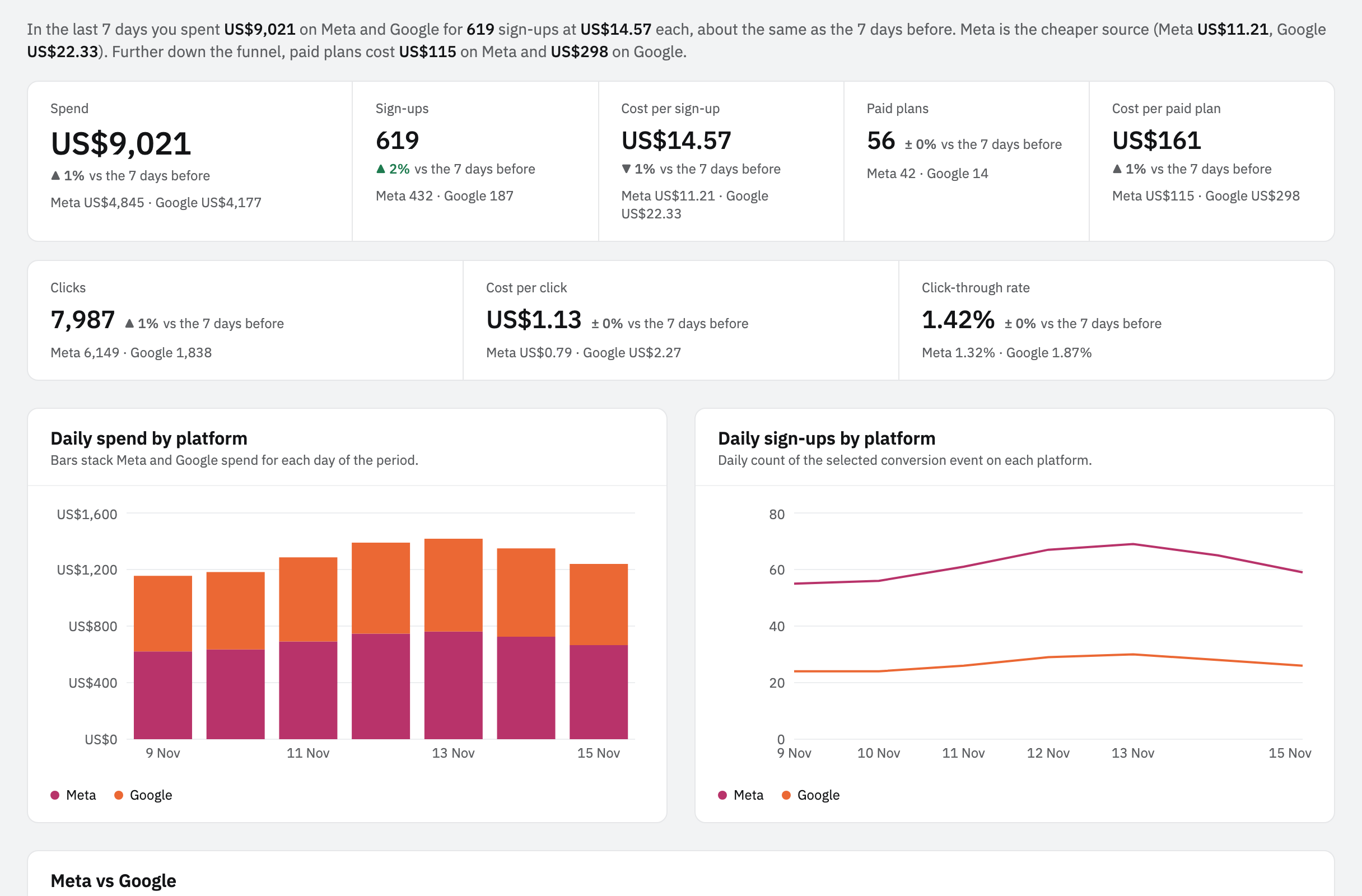
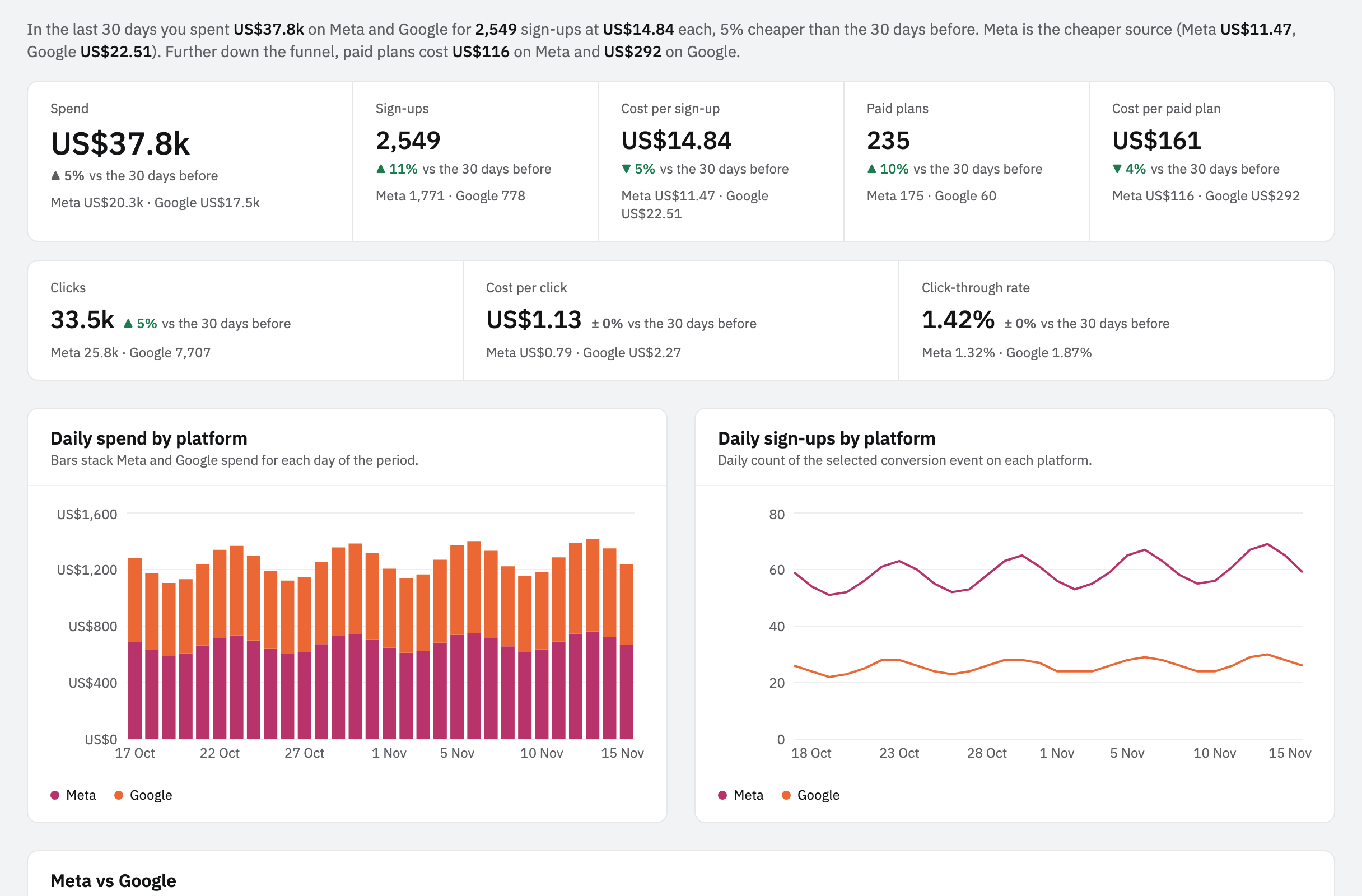
Paid Marketing · ACME CRM · compared with the period before
Refreshed every day
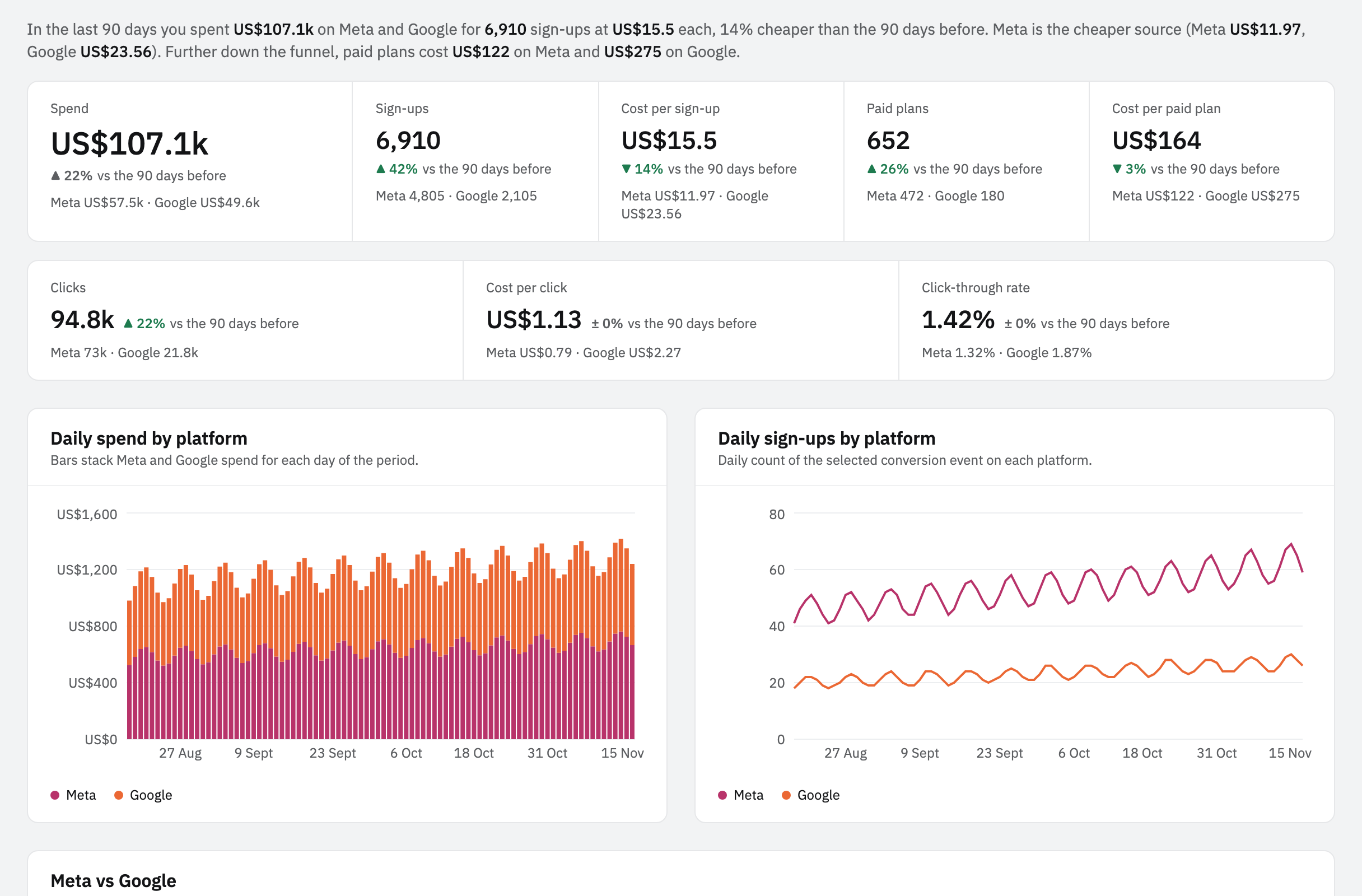
Paid Marketing overview for ACME CRM: the headline sentence (spend, sign-ups and cost per sign-up against the period before, Meta versus Google), figure tiles, and daily charts of spend and sign-ups by platform.Paid Marketing overview for ACME CRM: the headline sentence (spend, sign-ups and cost per sign-up against the period before, Meta versus Google), figure tiles, and daily charts of spend and sign-ups by platform.Paid Marketing overview for ACME CRM: the headline sentence (spend, sign-ups and cost per sign-up against the period before, Meta versus Google), figure tiles, and daily charts of spend and sign-ups by platform.The Meta Ads tab for ACME CRM: campaigns with reach, frequency, CPM and link clicks, then ad sets and ads.The Google Ads tab for ACME CRM: daily spend by campaign type, share of spend against share of sign-ups, and campaign types compared.The Recommendations tab for ACME CRM: priority counts, filters and the open recommendations.The Conversion setup tab for ACME CRM: the funnel stages with the Meta events and Google conversion actions that make up each.
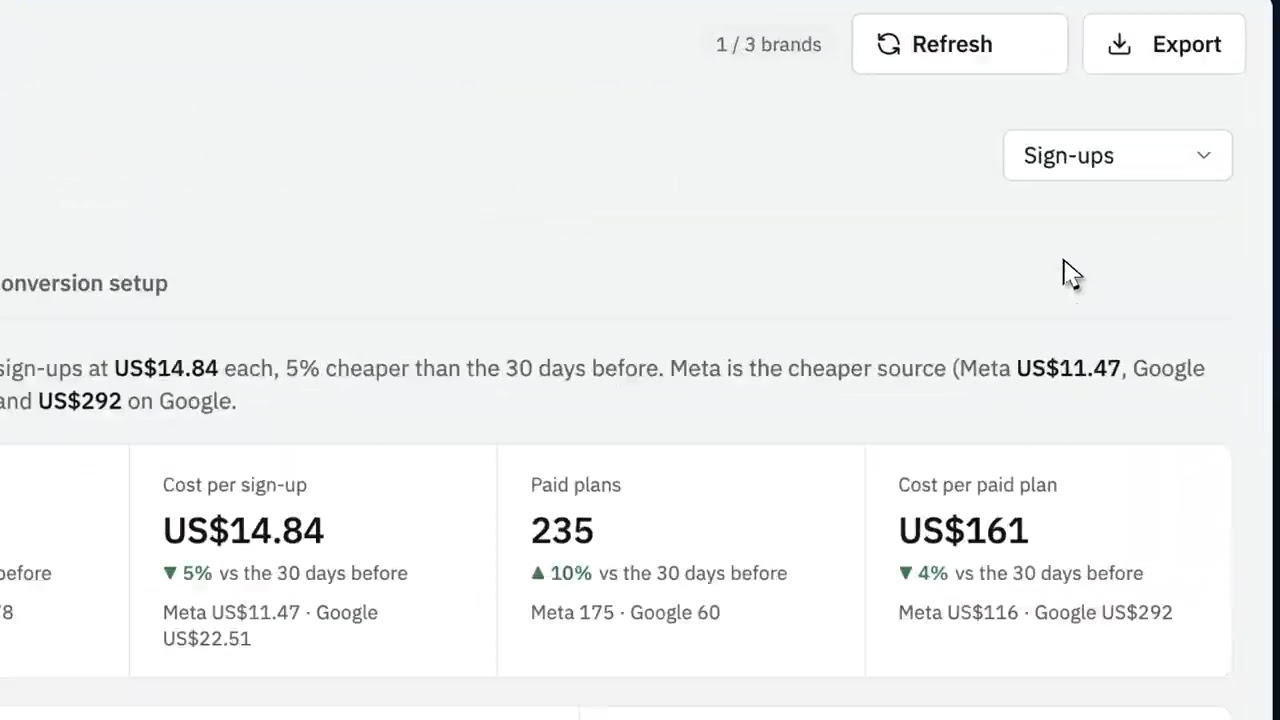
Exploring views automaticallyConversion event: Sign-ups

Trusted by brands investing in AI search visibility
Watch with sound
How it works

From two ad accounts to one answer: what does a customer cost?

The Ripplix team connects your accounts and maps the funnel with you. Ripplix does the arithmetic every day.

01

Connect

Meta Ads and Google Ads

The Ripplix team connects your ad accounts. Ripplix reads the figures and changes nothing in your campaigns.

02

Map

Your funnel stages

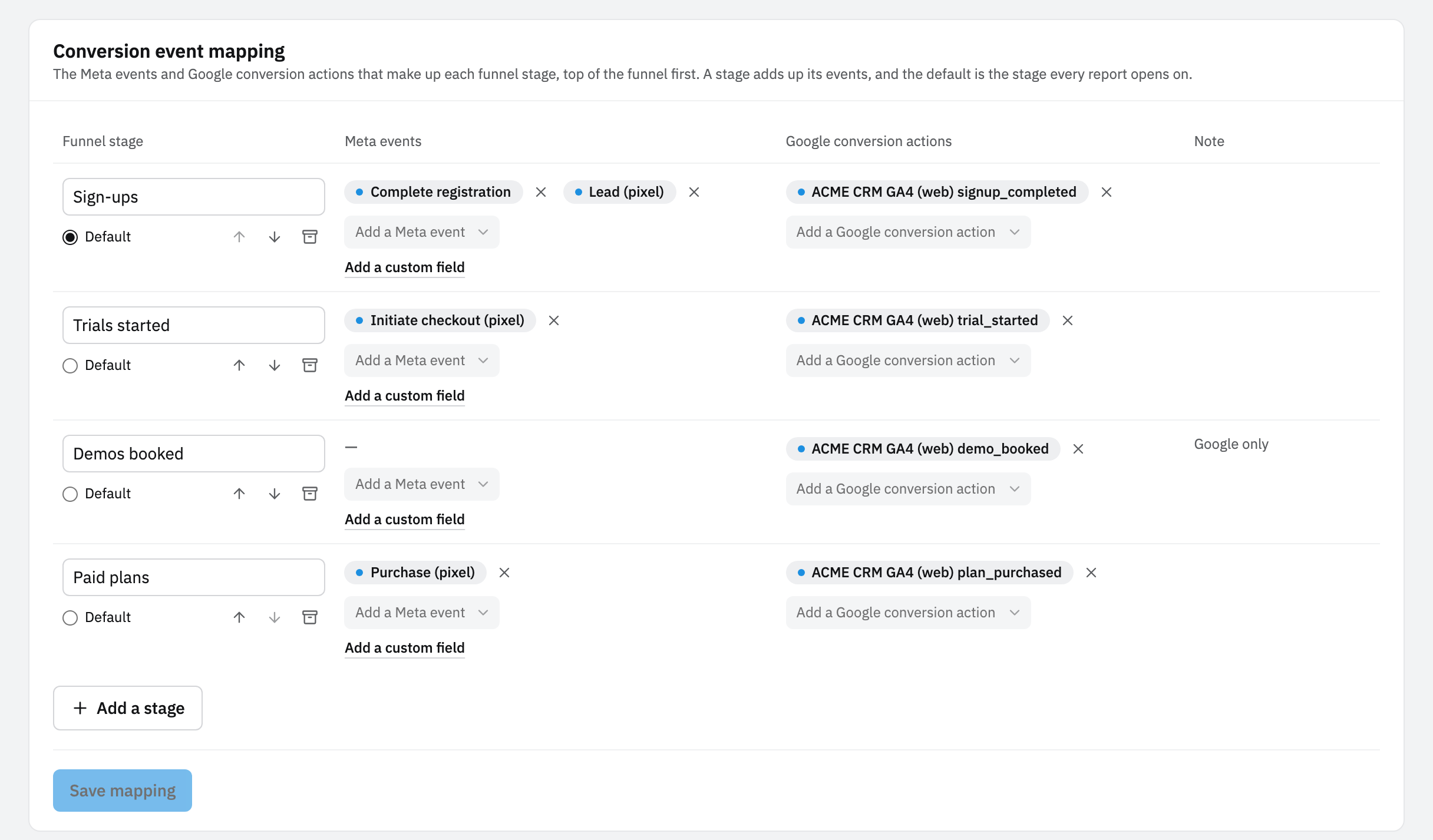
Name your stages once: sign-ups, trials, demos, paid plans. Pick the Meta events and Google conversion actions that make up each. Every report follows your map.

03

Measure

Cost per stage

Spend, clicks, cost per click and cost per stage, for Meta, for Google and in total, each against the same number of days just before.

04

Drill

Campaign to keyword

Open a campaign and its ad sets or ad groups appear right there, then its ads, keywords and search terms, and every figure narrows to what you opened.

05

Act

Recommendations

A ranked list of what to fix, with the spend each one affects. Fixed ones move to Resolved on their own.

Funnel by platform

Follow the money down the funnel, per network.

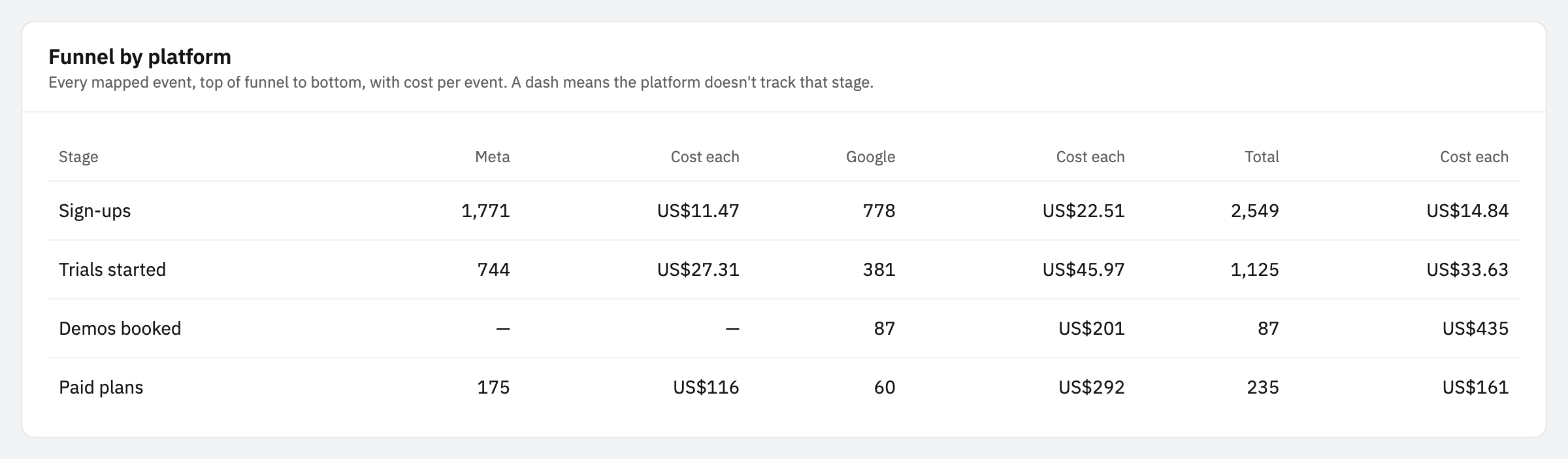
Every mapped stage from sign-ups to paid plans, with the cost per event on Meta, on Google and in total. ACME's month: a sign-up costs about twice as much on Google (US$22.51) as on Meta (US$11.47), and a paid plan about two and a half times (US$292 against US$116). Both networks, every stage, one screen.
Same period, same definitionsCost per event at every stageA dash where a network doesn't track a stage
Funnel by platform for ACME CRM: Sign-ups 1,771 on Meta at US$11.47 and 778 on Google at US$22.51; Trials started 744 and 381; Demos booked 87 on Google only; Paid plans 175 at US$116 and 60 at US$292.
All campaigns, both platforms

Spot the campaign that costs too much, at a glance.

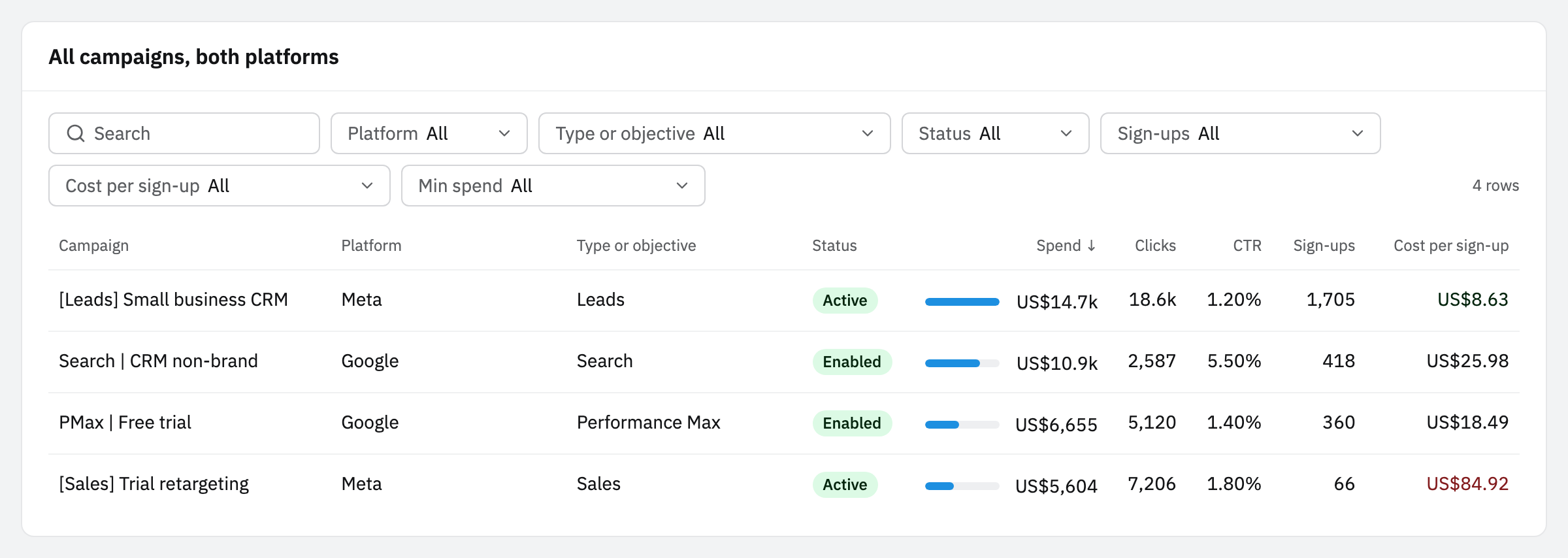
Every campaign from both networks in one table, sorted by spend, with its type or objective, status, clicks, click-through rate and cost per event. Cost turns red when it is far above the typical campaign and green when it is well below, so the outliers jump out before you scroll. Click a campaign to open it.
Meta and Google in one listRed and green on cost per eventSearch, filters and a minimum spend
All campaigns, both platforms, for ACME CRM: [Leads] Small business CRM on Meta at US$14.7k and US$8.63 per sign-up; Search | CRM non-brand on Google at US$25.98; PMax | Free trial at US$18.49; [Sales] Trial retargeting at US$84.92, in red.
Google Ads

See where Google's budget runs out, and why.

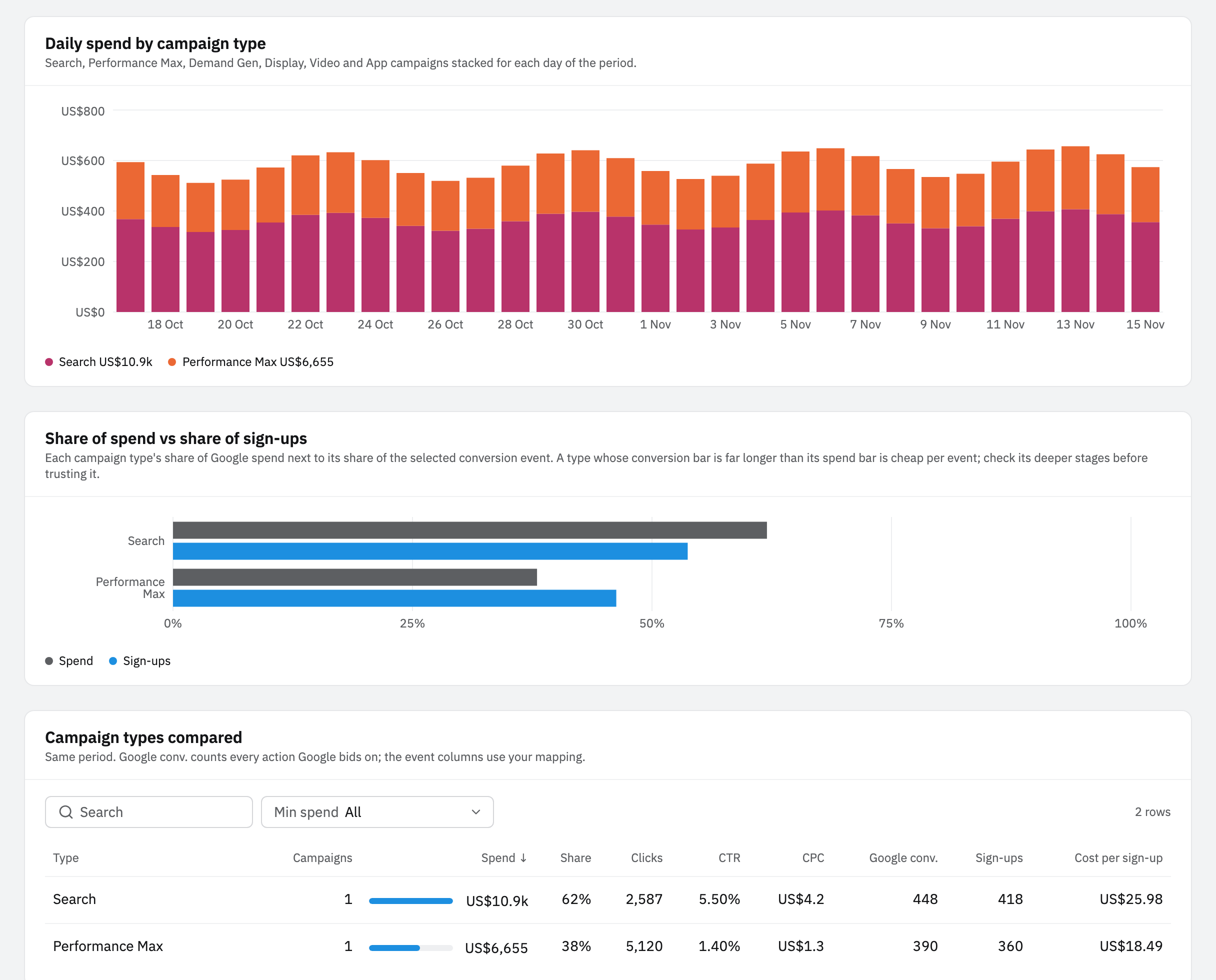
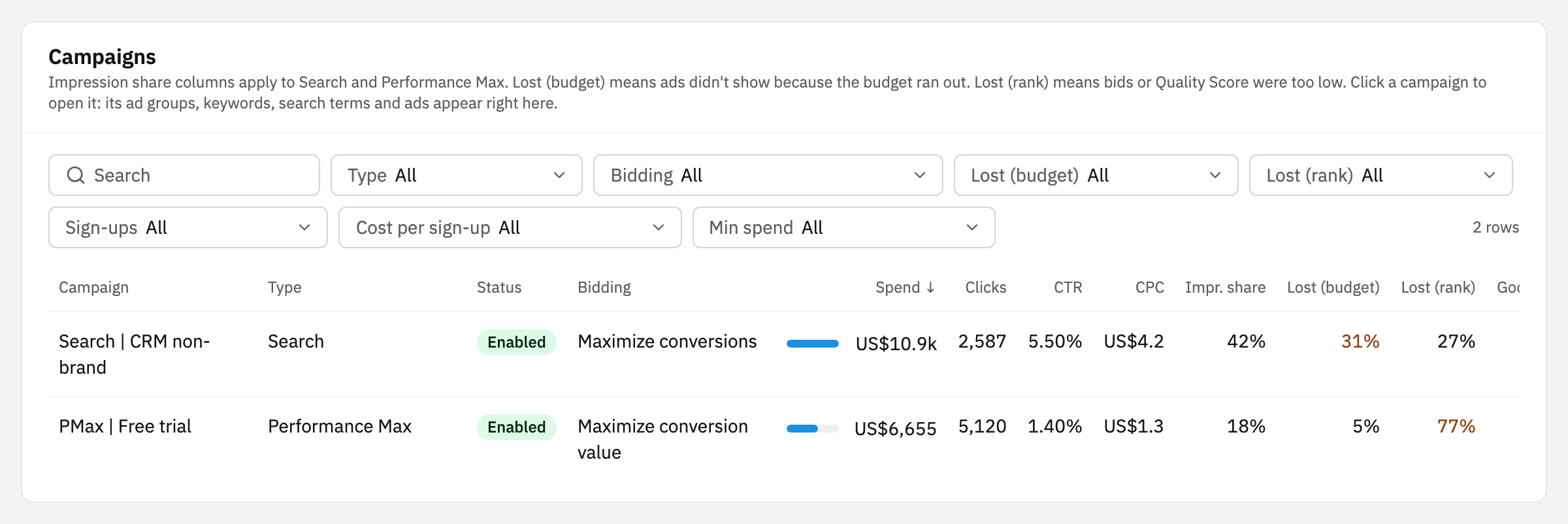
Impression share for every Search and Performance Max campaign, split into what was lost to budget and what was lost to rank. Quality Score beside every keyword. What people actually typed, and a flag on search terms that cost far more than your average. Campaign types, devices and ads compared.
Impression share, lost to budget or rankAd groups, keywords, search terms and adsQuality Score and ad strength
Google Ads campaigns for ACME CRM: Search | CRM non-brand with 42% impression share, 31% lost to budget (flagged) and 27% lost to rank; PMax | Free trial with 18% impression share and 77% lost to rank (flagged).
Meta Ads

Frequency, placements and who converts cheapest.

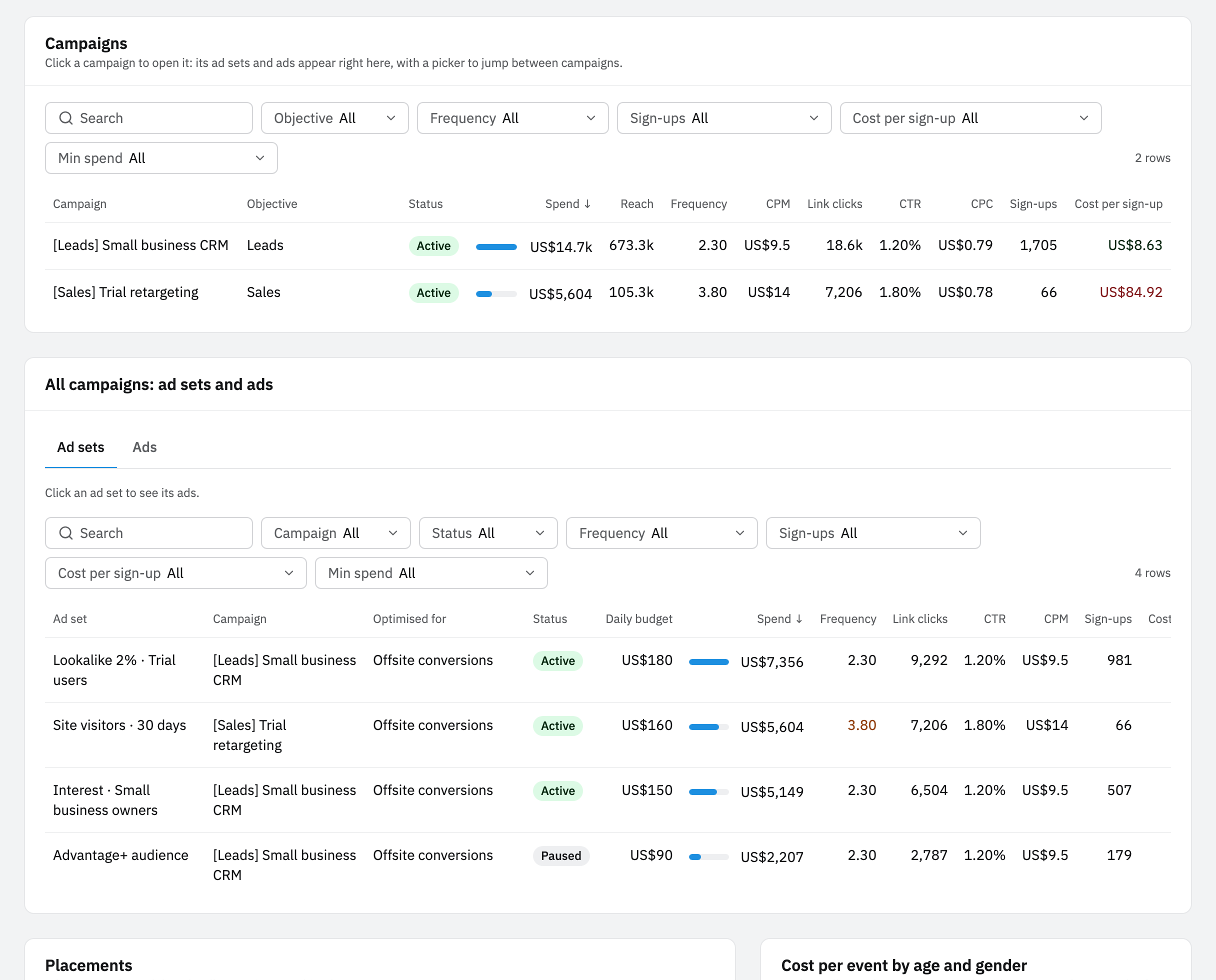
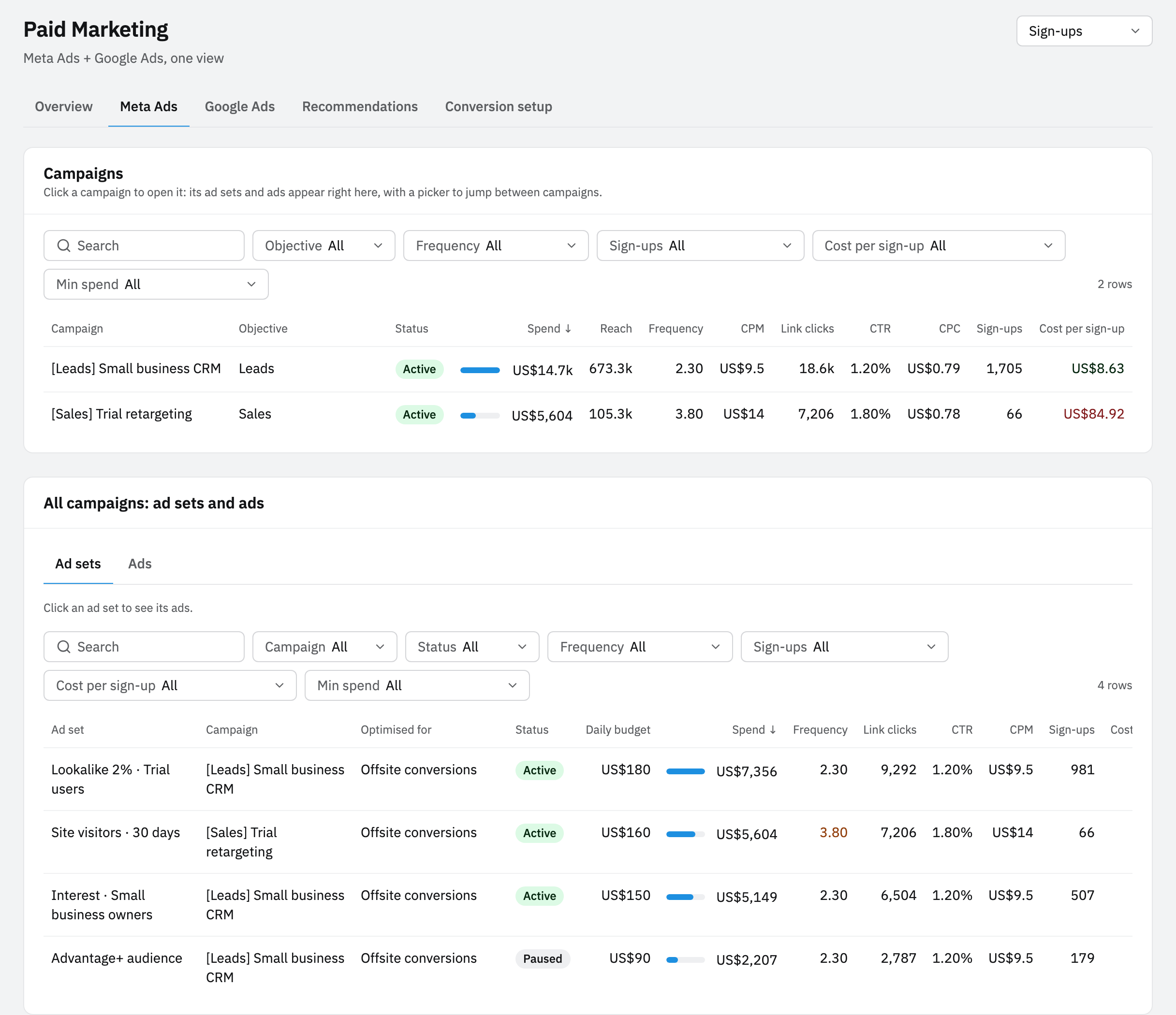
Campaigns open into their ad sets and ads. A frequency of 3.5 or more is flagged, so you see ad fatigue before the cost per event tells you. Meta's own quality, engagement and conversion rankings sit beside each ad. Placements show where the ads ran, and a heat grid shows cost per event by age and gender.
Campaigns, ad sets and adsPlacements, with cost per eventCost per event by age and gender
The Meta Ads tab for ACME CRM: two campaigns ([Leads] Small business CRM at US$8.63 per sign-up; [Sales] Trial retargeting at US$84.92, in red) and four ad sets with daily budget, spend, frequency (3.80 flagged), link clicks, CTR and CPM.

Stop reading Meta and Google in two tabs.

One screen, your funnel, both networks. Book a call and the Ripplix team connects your accounts.

Recommendations

A to-do list, written for your media buyer.

Ripplix reviews your ad accounts every day: tracking, budget, bidding, keywords, search terms, creative, audiences, landing pages and more. Each recommendation names the finding, the action, the expected result and the spend it affects.
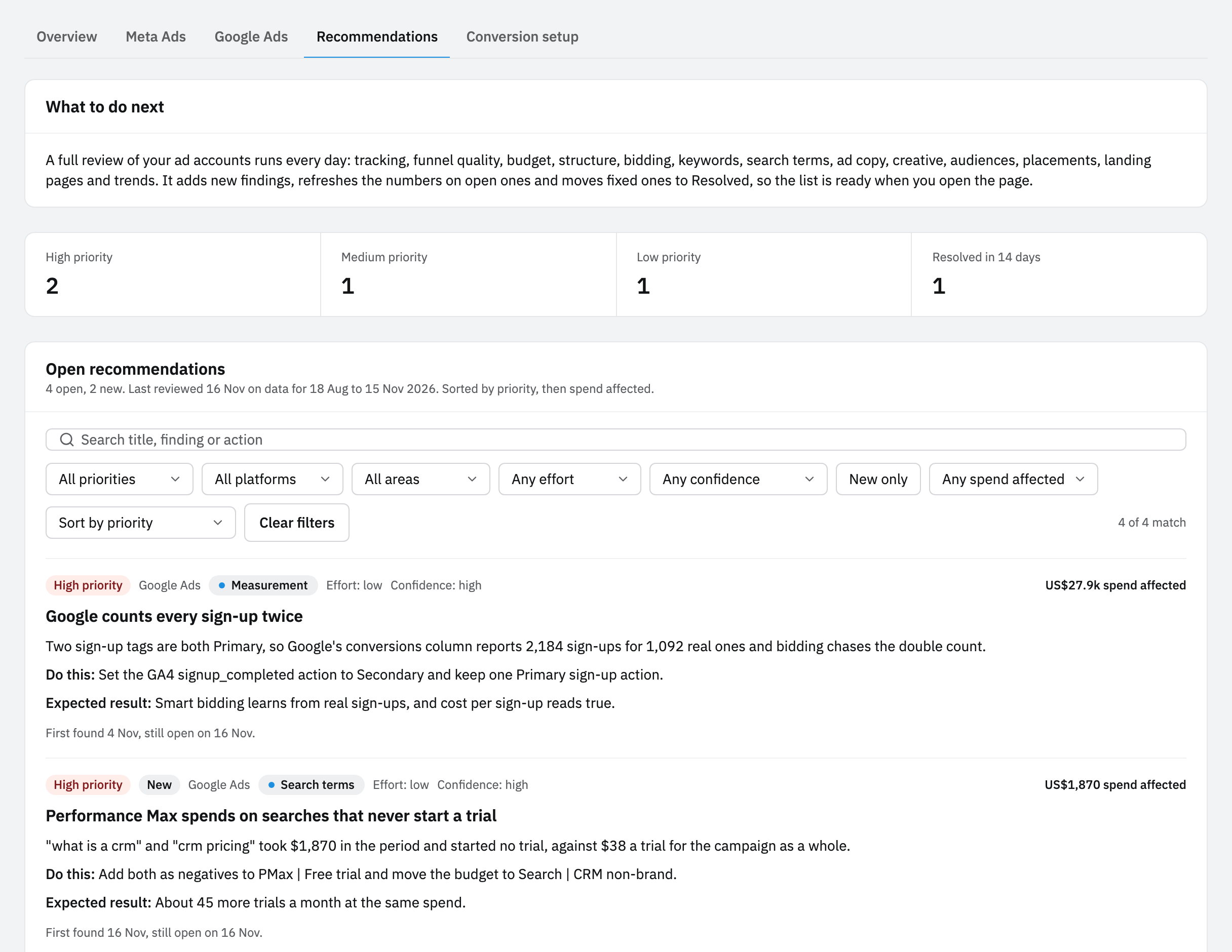
Recommendations · ACME CRM · 4 open, 2 new · sorted by priority, then spend affected
Reviewed today
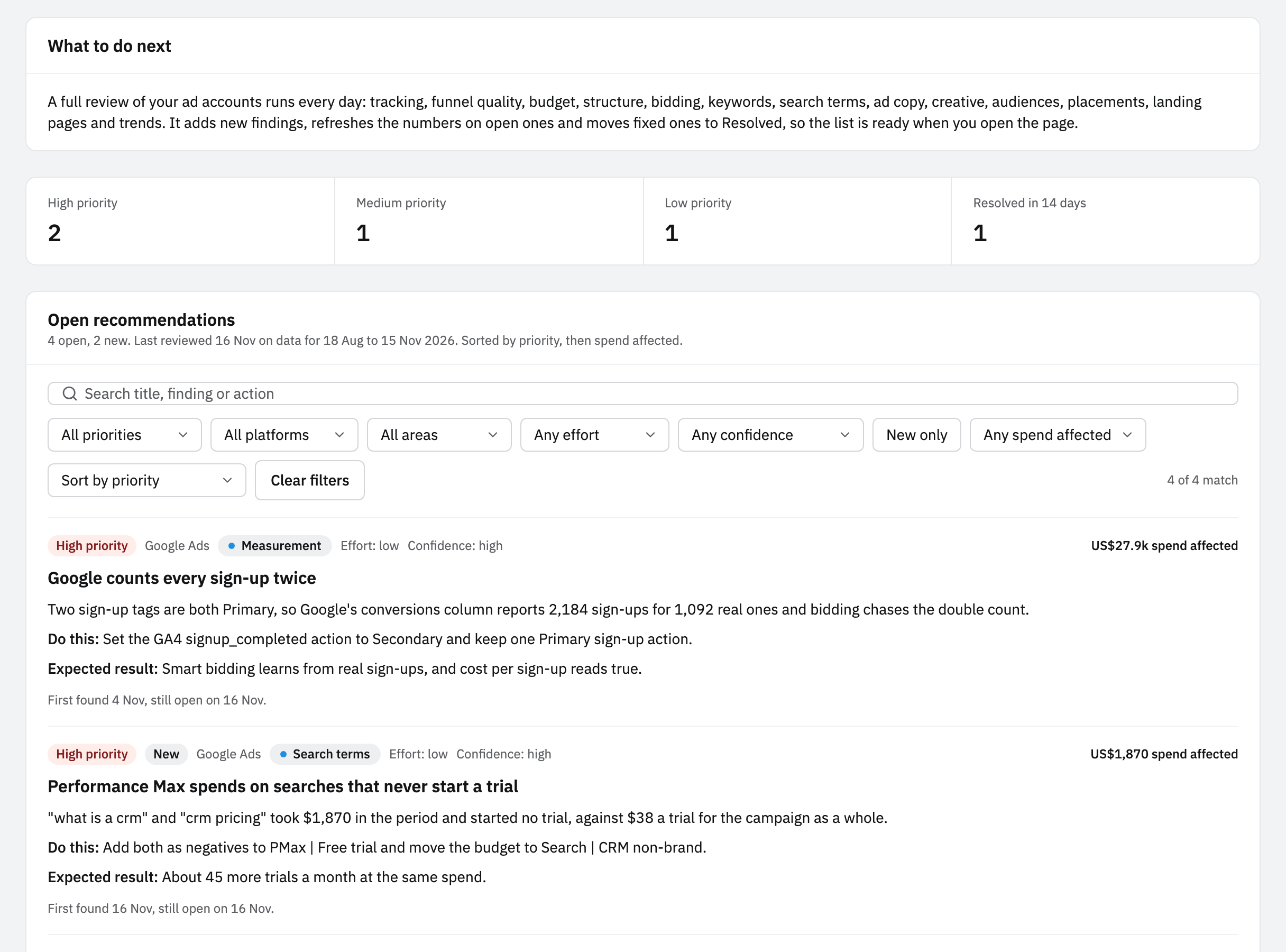
The Recommendations tab for ACME CRM: counts of 2 high, 1 medium, 1 low and 1 resolved in 14 days; filters; and cards with a title, the finding, Do this, Expected result and when each was first found.
Priority, platform, area, effort and confidence on every cardOpen, new and resolved, in one list

ACME's list opens with Google counting every sign-up twice (US$27.9k of spend affected) and Performance Max spending on searches that never start a trial.

Built around your funnel

Your stages, your names, your numbers.

Conversion setup

Map the Meta events and Google conversion actions that make up each funnel stage, top of the funnel first. Every tile, table and cost on every tab follows your map, and the Ripplix team changes it with you whenever your tracking does.

Any range up to 90 days

7, 30 or 90 days, refreshed every day, or a custom range of your own, always compared with the same number of days just before. A Refresh button fetches the latest figures for any range.

Export for the Monday meeting

Every tab exports as a PDF, with the range and the conversion event you picked, so the people who do not log in still see the numbers you saw.

Know what a customer costs, on both networks, every day.

Start with your free AI Visibility Report, then ask for Paid Marketing: we set it up for you, connect your ad accounts and map your funnel with you.

FAQ

Everything you wanted to know about Paid Marketing.

Short answers. For the long ones, talk to us.

Which ad networks does Paid Marketing cover?
Meta Ads (Facebook and Instagram) and Google Ads (Search, Performance Max, Demand Gen, Display, Video and App campaigns). If you run only one of them, you see that network's tab, Recommendations and Conversion setup.
Do I have to give Ripplix access to my ad accounts?
We connect your accounts with read access. Ripplix reads the figures and changes nothing in your campaigns: no bids, budgets or ads are touched.
How fresh are the numbers?
Figures appear as soon as your accounts are connected, with the last 90 days behind them. The 7, 30 and 90-day views refresh every day, and the Refresh button asks for the latest whenever you want. Saved figures show at once while fresh ones load behind them.
What is a funnel stage, and why map one?
A stage is a step buyers take: a sign-up, a trial, a demo, a paid plan. Meta and Google each name these differently; your map says which Meta events and Google conversion actions mean the same thing. From then on every cost and every comparison is on your definition, not the networks'.
Where do the recommendations come from?
Ripplix reviews your ad accounts every day and publishes what to fix into your page. Each one carries its priority, platform, area, effort, confidence and the spend affected. Fixed ones move to Resolved and stay visible for 14 days; nothing is deleted.
Can I look at one campaign on its own?
Yes. Open a campaign and its ad sets (Meta) or ad groups (Google) appear in place, then its ads, keywords and search terms, and every figure narrows to what you opened. A picker jumps between campaigns without leaving the page.
How does this fit with AI visibility?
It is the same account: your AI visibility screens, SEO and Paid Marketing sit side by side in one login, with one team behind them. The pages your ads send people to are the pages AI answers cite, so you work on them in one place.
How do I get Paid Marketing, and what does it cost?
We set it up for you: we connect the accounts and map your funnel with you. Pricing depends on your plan, so talk to an AI visibility expert to ask for it.