
User manual · 04
Getting around, and Overview
The left menu has four parts. Overview is the front page. Analytics shows what AI says about you. Optimize helps you change it. Settings controls what Ripplix measures and holds your account.
The bar at the top of every screen
The bar along the top controls what each screen shows.
| Control | What it does |
|---|---|
| Brand name | Shows which brand or product you are looking at. If your account tracks more than one, pick another here. |
| 7d · 30d · 90d · All | Sets the period the screen covers. |
| All models | Narrows the screen to one AI assistant. |
| All topics | Narrows the screen to one topic. |
| 1 / 3 brands | How many brands your plan allows, and how many you use. |
| Refresh | Reloads the screen with the latest data. It does not ask the assistants again. |
| Export | Downloads a CSV of the screen's charts and tables, or a PDF of the page. Content Optimization and Win/Loss offer the PDF only, and Settings screens have no Export. |
Overview: your AI visibility snapshot
Overview is the one page to read if you read nothing else. It tells the story of how AI sees your brand, in plain sentences and a handful of numbers, and explains why.
Overview is a snapshot, made again every week; Generated shows when. It always covers the past month and does not follow the date, model and topic pickers. For the latest day-by-day figures, see Visibility.
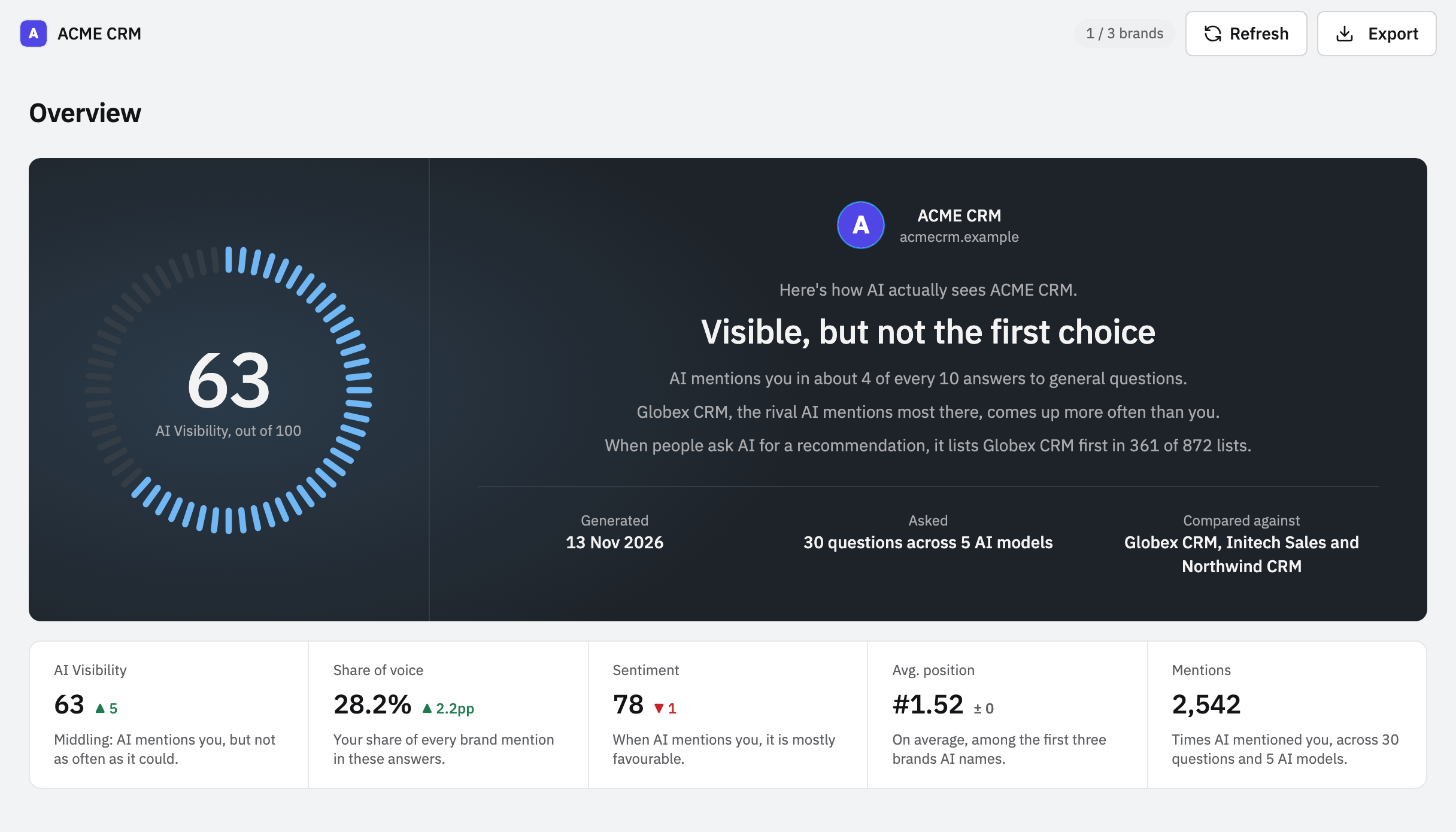
The headline
The large dial is your AI Visibility score out of 100. Next to it, one sentence sums up your situation. For ACME it says Visible, but not the first choice, followed by three facts in plain words:
- "AI mentions you in about 4 of every 10 answers to general questions."
- "Globex CRM, the rival AI mentions most there, comes up more often than you."
- "When people ask AI for a recommendation, it lists Globex CRM first in 361 of 872 lists."
Under it, Generated says when the snapshot was made, Asked says how many questions it covers on how many AI models, and Compared against names your competitors.
The five cards
Right under the headline sit AI Visibility, Share of voice, Sentiment, Avg. position and Mentions, the first four with their change against the period before, and each with one short sentence that explains it. ACME's read: visibility 63 (up 5), share of voice 28.2% (up 2.2 points), sentiment 78 (down 1), average position #1.52 (no change), and 2,542 mentions.
Why your score looks like this
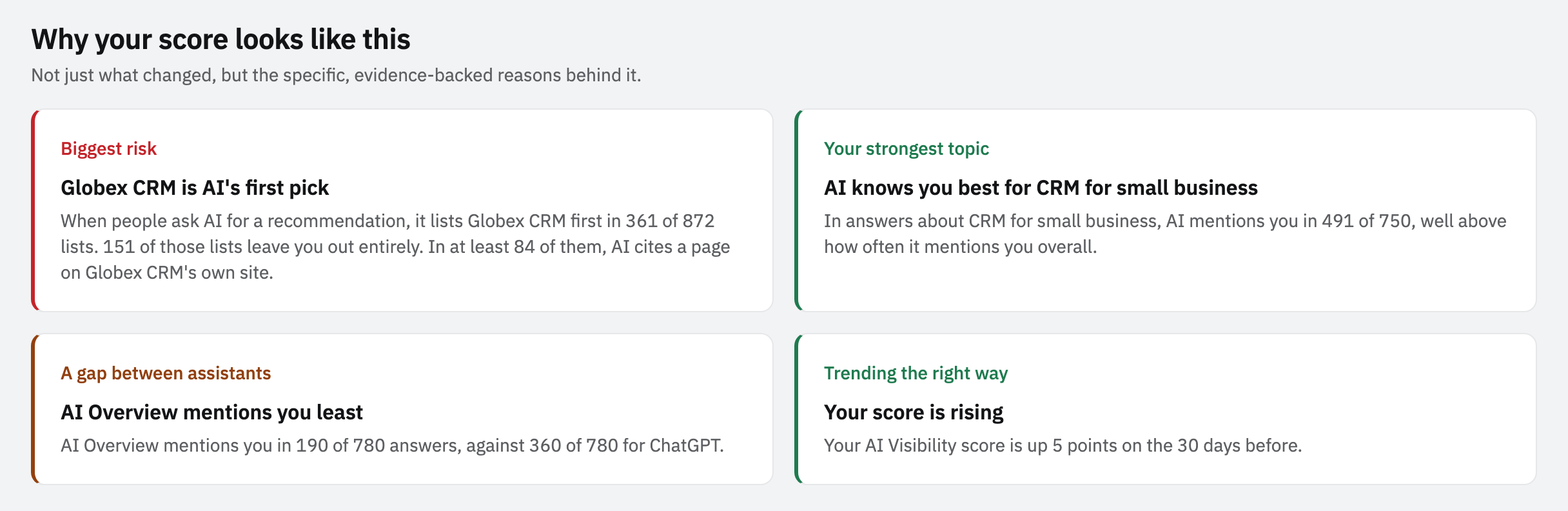
Short cards explain why your score is what it is, each with the evidence behind it. ACME sees four:
- Biggest risk: Globex CRM is AI's first pick. Many of those lists leave ACME out entirely, and in many of them AI cites a page on Globex's own site.
- Your strongest topic: AI knows you best for CRM for small business. AI mentions ACME in 491 of 750 answers on that topic, about two in every three.
- A gap between assistants: AI Overview mentions you least. AI Overviews names ACME about half as often as ChatGPT does.
- Trending the right way: Your score is rising. Up 5 points on the 30 days before.
Depending on your data you may also see cards such as A blind spot (a topic where AI never mentions you), Who AI names instead, Neck and neck, Your edge or Trending down.
How you stack up
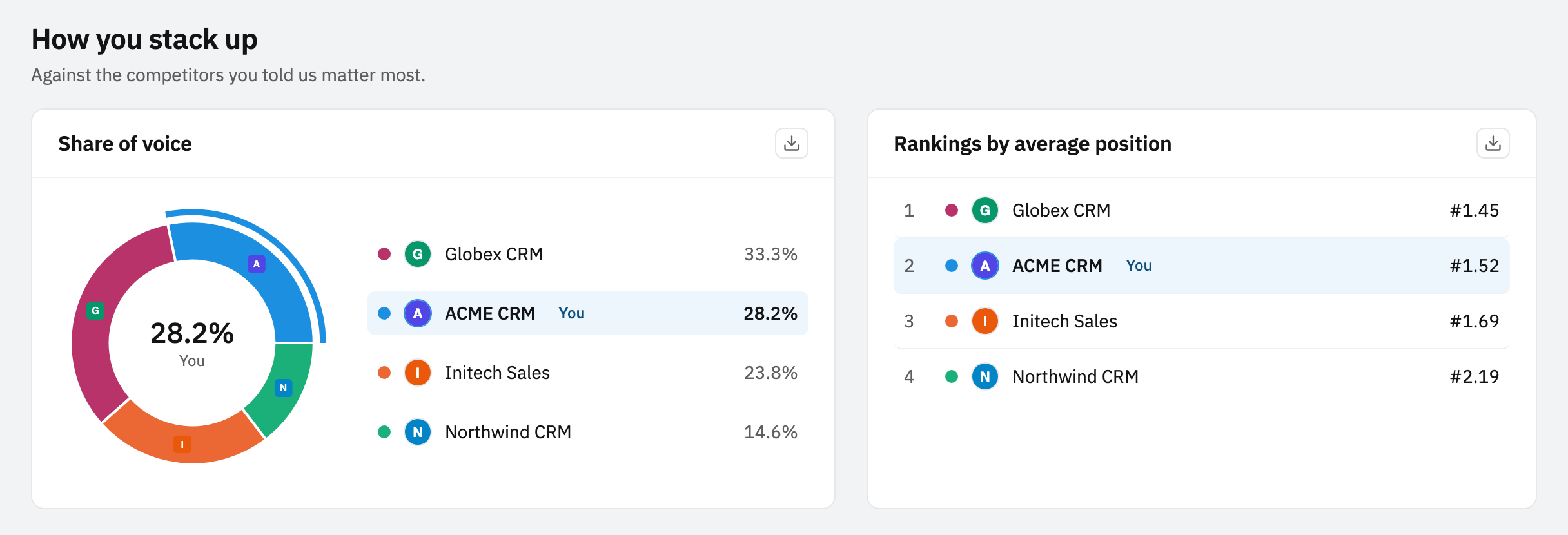
Share of voice shows how the conversation is split between you and your competitors, and Rankings by average position shows who tends to be named first. ACME holds 28.2% of the conversation against Globex's 33.3%, and sits second in the rankings at #1.52.
How AI describes your brand
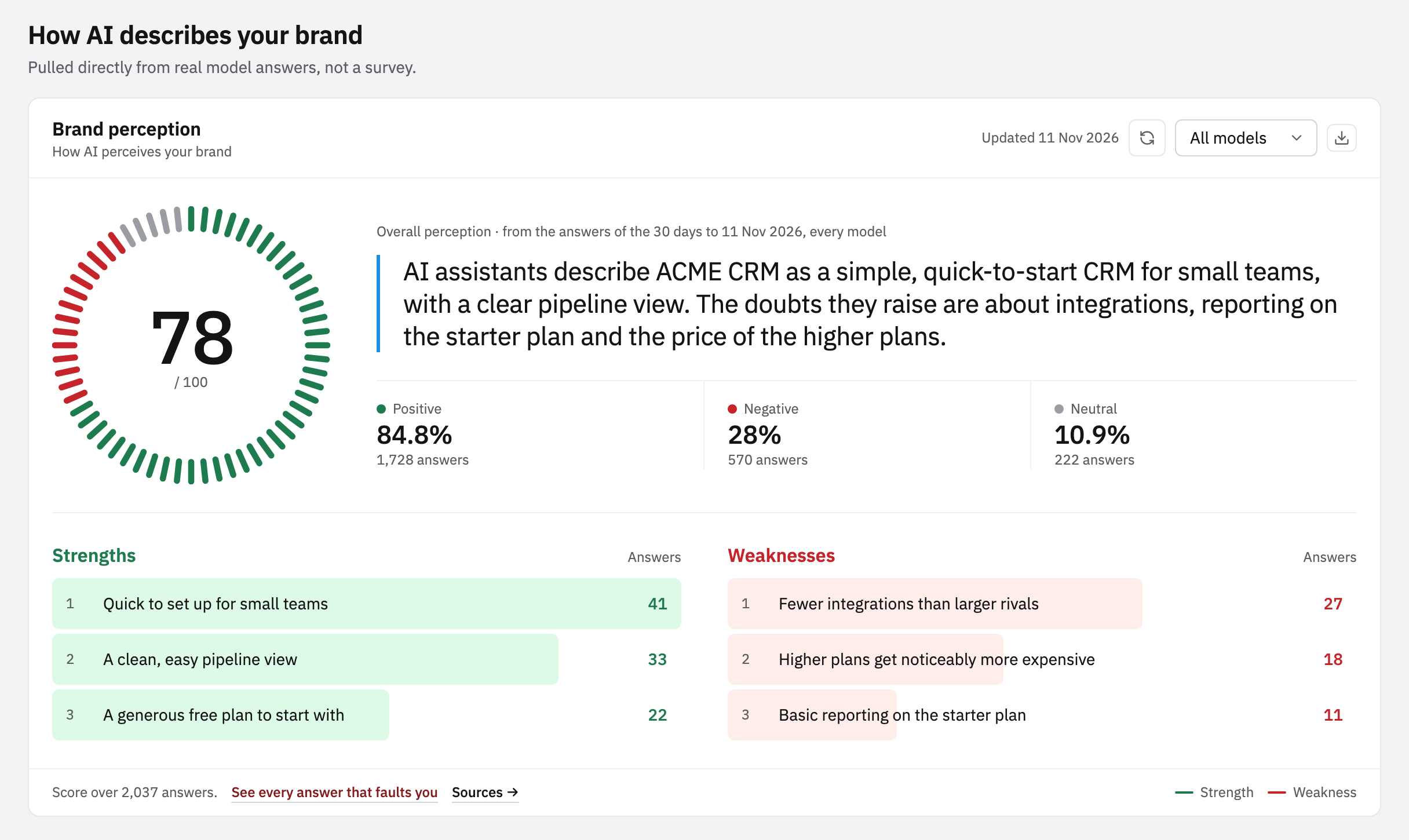
The Brand perception panel puts your sentiment score next to a short summary of what AI says about you, the split of positive, negative and neutral answers, and your top Strengths and Weaknesses, each with the number of answers behind it. ACME's top two strengths are "Quick to set up for small teams" (41 answers) and "A clean, easy pipeline view" (33). Its top two weaknesses are "Fewer integrations than larger rivals" (27) and "Higher plans get noticeably more expensive" (18).
Where you actually show up
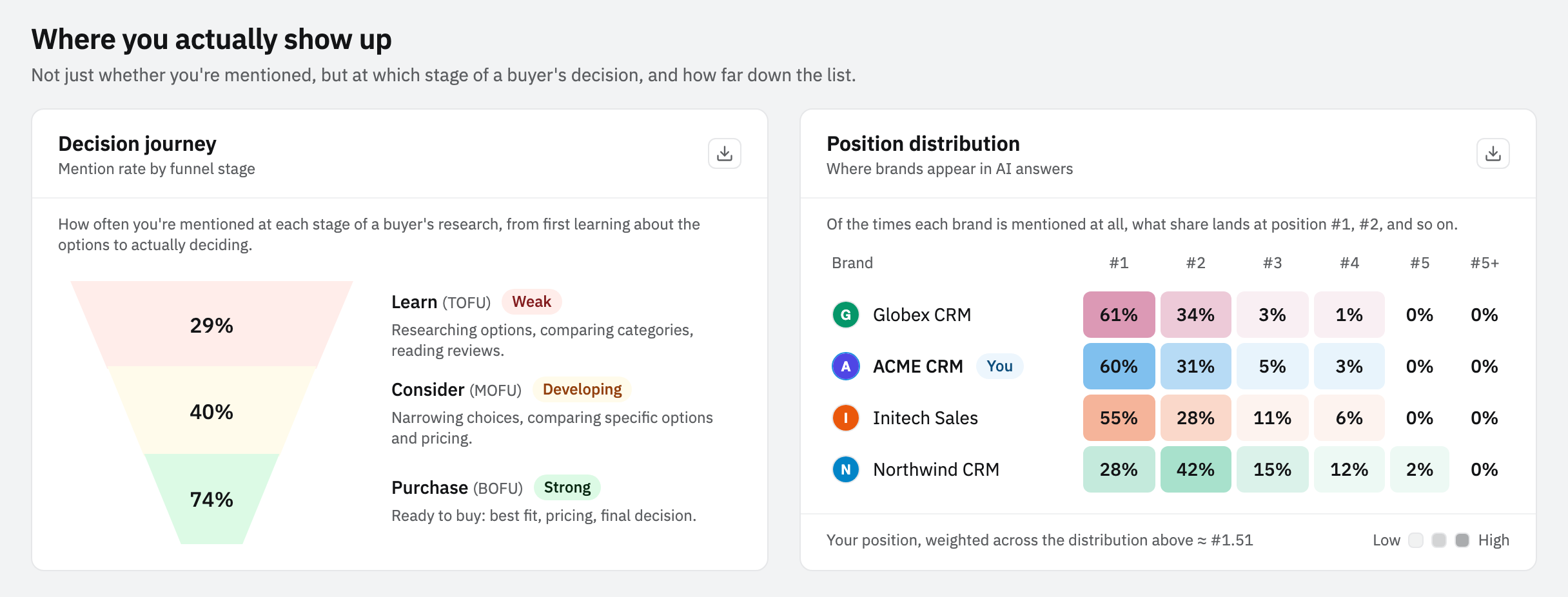
- Decision journey shows how often you are mentioned at each stage of a buyer's research: Learn, Consider and Purchase, each marked Strong, Developing or Weak.
- Position distribution shows, for each brand, how often it lands at #1, #2, #3 and lower when it is mentioned.
ACME is Weak at Learn (29%), Developing at Consider (40%) and Strong at Purchase (74%).
How you rank, topic by topic
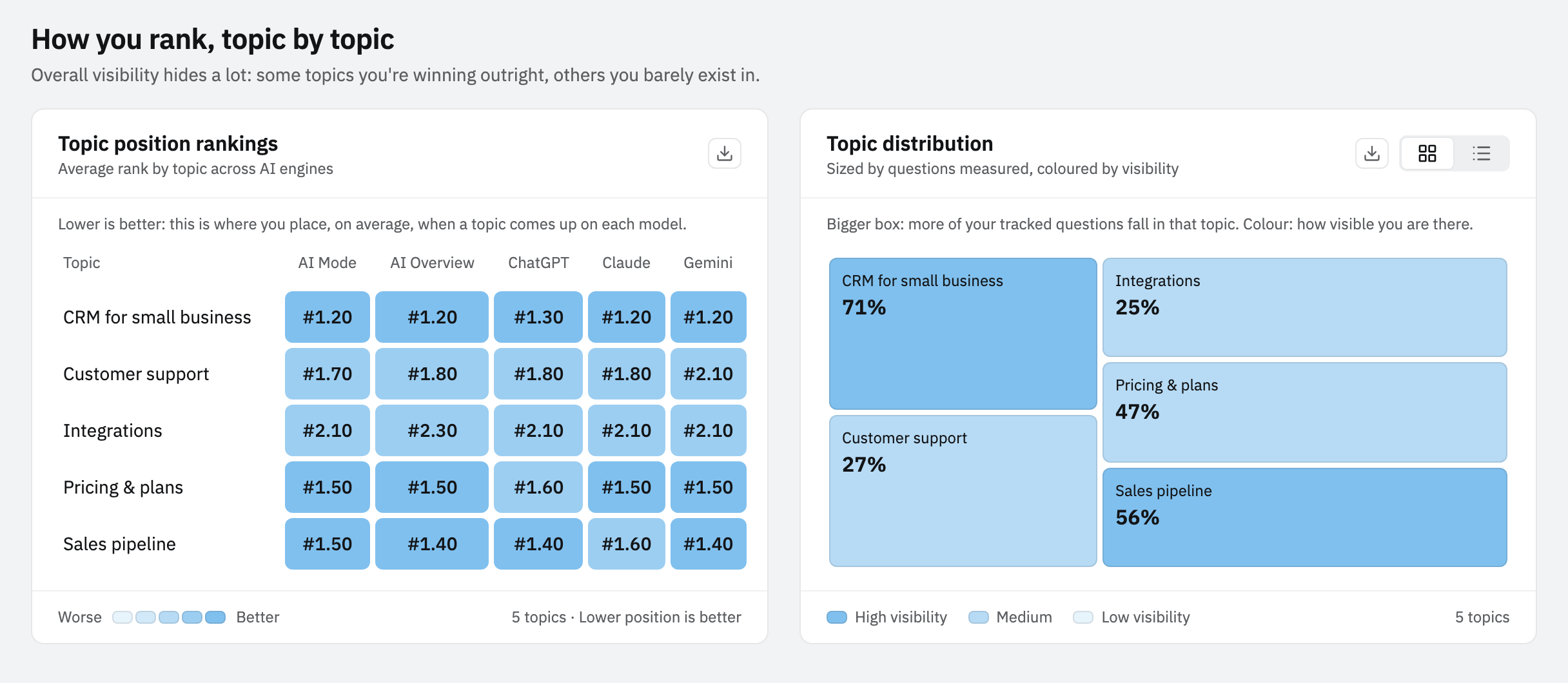
Topic position rankings shows your average place in each topic on each AI model, where darker is better. Topic distribution shows each topic as a box, sized by how many of your questions it holds and coloured by how visible you are there.